
The panel finds 'discrepancy' in the Annual Survey of Industries data.

The number of individuals claiming unemployment benefits declined by 32,300 to 1.59 million.

The Index of Industrial Production (IIP) grew by 1.4 per cent in November as most components like manufacturing, electricity, mining, primary goods, and consumer durables witnessed a slowdown, according to data released by the National Statistical Office (NSO) on Wednesday. This is on the base of a decline of 1.7 per cent in November 2020 and before the new Covid variant started impacting economic activity. IIP growth was lower than the 4 per cent expansion recorded in the previous month but was better than a 1.6 per cent contraction seen in November 2020. Separately, rising prices of kitchen staples pushed retail inflation, or rate of price increase, to 5.59 per cent in December 2021, bringing it close to the upper band of Reserve Bank's comfort zone.

Lawyers, doctors, accountants and other professional men are also consuming above average amounts of alcohol 20 units a week according to figures from the Office of National Statistics in UK.

'The 2020 assembly election was a Tejaswi Yadav election; whereas this is a Lalu Yadav election. It is his plan.'
The economy contracted by 1.5 per cent between October and December, more than the quarterly declines seen during the recession in the 1990s. The last quarter decline came on top of a 0.6 per cent slump in the third quarter of 2008. Two or more consecutive quarters of contraction are regarded as a recession.

Nearly 40 per cent of IITians sitting for placements in 2024 are yet to receive job offers, showing a doubling of the 'unplaced' in the last three years from 19 per cent in 2021-2022 to 38 per cent in 2023-2024.

Declining vegetable prices brought down the retail inflation to a 15-month low of 4.59 per cent in December and within the comfort zone of the Reserve Bank, government data showed on Tuesday. It is for the first time during the current fiscal that the Consumer Price Index (CPI) based inflation print is below 6 per cent or in the RBI's target range of 2 to 6 per cent. The central bank factors in the CPI-based inflation while arriving at its monetary policy. The inflation in December 2020 came down from 6.93 per cent in November, mainly on account of 10.41 per cent decline in vegetable prices over the year-ago period.

Going by the latest data, the unemployment rate rose by 0.1 per cent to 7.9 per cent for the three months to April.

'When the average growth in the last three years was just 2.5%, how does that make us the fastest growing country?' 'They only tell you what has happened in the last 2 years; they are not taking into account what happened in FY21 on account of their mistakes.'
According to British Office for National Statistics, women in their forties were the biggest losers in the pay divide as they earned an average of 20 per cent less than the men. The findings revealed that female managers were likely to experience an even wider salary gap. Even as women start with earning roughly the same as men the pay divide widens with age after women interrupt their career to have children. Pay gap increases in line with the number of children a woman has.

'The kind of situation we are seeing...we don't believe that this can happen in a settled democracy like India'
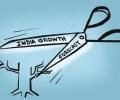
Global forecasting firm Oxford Economics on Monday revised downwards its India GDP growth forecast for 2021 to 10.2 per cent from 11.8 per cent previously, citing the country's escalating health burden, faltering vaccination rate and lack of a convincing government strategy to contain the pandemic. Oxford Economics also said that notwithstanding the likelihood of further mobility restrictions, it expects India's targeted lockdown approach, less stringent restrictions, and resilient consumer and business behaviour to mitigate the economic impact of the second wave.
Jaguar's plan to cut 300 more jobs at its Halewood plant comes at a time when unemployment numbers in the UK have risen to record levels, at 2.38 million.

To check digital frauds, the government has disconnected 70 lakh mobile numbers so far involved in cybercrime or financial frauds, Financial Services Secretary Vivek Joshi said on Tuesday. Emerging from a meeting to discuss issues related to financial cyber security and increasing digital payment fraud, Joshi, who chaired the meeting, said banks have been asked to strengthen the system and processes in this regard. More such meetings would take place, he said, adding the next meeting is scheduled in January.

Earlier, the CSO in its advance estimate had pegged the GDP growth rate for 2018-19 at 7.2 per cent.

The Bill states a worker will be paid twice his or her wage if he or she is allowed to work overtime. A majority of workers in India worked more than 48 hours in a week, which is higher than the International Labour Organisation's prescribed time-limit.

The most important institutions have been and are being undermined with almost no resistance, warns Aakar Patel.

This time there has been a rather peculiar criticism of the latest GDP numbers.

A massive fire that ripped through a seven-storey shopping mall in Dhaka overnight killed at least 46 people and injured 22 others, the government said on Friday, in one of the worst infernos to hit Bangladesh in recent years.

During the six-month period (April-September 2019), the Indian economy grew 4.8 per cent as against 7.5 per cent in the same period a year ago.

India's factory output climbed 22.4 per cent in March, benefiting from the base effect of the lockdown-marred month a year back as well as a turnaround in the manufacturing sector, while retail inflation slipped to a three-month low of 4.29 per cent in April. The high positive annual growth in the index of industrial production (IIP) in March 2021 came on back of a contraction of (-)0.9 per cent and (-)3.4 per cent in January and February 2021 respectively, according to the data released by the National Statistical Office (NSO) on Wednesday. This turnaround was led by recovery in the mining, manufacturing and electricity sectors.

The Supreme Court on Wednesday refused to entertain a plea by 14 political parties led by the Congress alleging arbitrary use of central probe agencies against opposition leaders, asserting that laying down guidelines without facts of a criminal case will be "dangerous".

Beside manufacturing, deceleration was also witnessed in sectors like agriculture, construction and electricity, gas and water supply.

To enable widen the fiscal deficit beyond the permissible limit under the present legislation, the government may have to propose amendment to the FRBM Act in the Finance Bill.
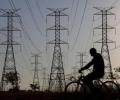
Most of the economic activity in the country had come to a standstill after the government imposed a 21-day nationwide lockdown beginning March 25 to check the spread of coronavirus.

There should have been a focus on sanitation and not on littering or garbage. Absence of sanitation affects the health of children, explains Aakar Patel.

India's GDP estimates for 2020-21 show that the economy is expected to perform much better than earlier projections by different agencies, indicating a sustained V-shape post-lockdown recovery, experts said. The first Advance Estimates (AE) by the National Statistics Office (NSO) has projected a contraction of 7.7 per cent in the real GDP during 2020-21. This was better than the projections by certain international agencies like the IMF and World Bank.
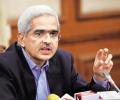
Softening inflation, Das said would make available more policy space to the central bank to address risks to the growth going forward.

While India should be concerned about disparities, the fact is that whereas three decades ago about half the people had incomes greater than $2.15 a day, today seven out of eight do, notes T N Ninan.

India's industrial production contracted by 3.6 per cent in February, official data showed on Monday. According to the Index of Industrial Production (IIP) data released by the National Statistical Office (NSO), manufacturing sector output declined by 3.7 per cent in February 2021. Retail inflation rose to 5.52 per cent in March, mainly on account of higher food prices, government data showed on Monday. The consumer price index (CPI) based retail inflation stood at 5.03 per cent in February.

But the ISI chief did not retire giving the impression that he has won General Asim Munir's trust, notes Rana Banerji who headed the Pakistan desk at RA&W.
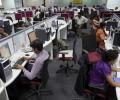
However, the government has enacted an important change to the fixed-term employment framework that may help companies in handing out contractual jobs to its existing permanent workforce.

The pace of retail price rise in January 2016 is the highest since 6.46 per cent in September 2014.

It is high time to rethink the entire recruitment process for the civil services, the Department-related Parliamentary Standing Committee on Personnel, Public Grievances, Law and Justice opined in its latest report.

Expect a more modest out-turn of around 5 per cent (if not less) because of the longer-term scarring effects of the Covid shock, the sharply slowing growth in the pre-Covid years and some scepticism about the growth-efficacy of some of recent official policy initiatives, explains Shankar Acharya, former chief economic advisor to the government.

The latest Office for National Statistics data takes the UK's figure past the 29,079 in Italy -- so far with the region's highest death toll from the deadly virus.

Most economists were of the view that the NSSO should release the data, as any move to withhold it will dent the image of country's statistical system.

India's economy recovered faster than expected in the September quarter as a pick-up in manufacturing helped GDP clock a lower contraction of 7.5 per cent and held out hopes for further improvement on better consumer demand. The gross domestic product (GDP) had contracted by a record 23.9 per cent in the first quarter of the 2020-21 fiscal (April 2020 to March 2021) as the coronavirus lockdown pummelled economic activity.
